Is Radiology Tech a Good Career? Pros and Cons (2026)

See if you qualify for Radiology Technician programs
Answer a few questions in 2 minutes. Free, no commitment.
Radiology tech is a good career for people who want hands-on healthcare work without a four-year degree. Radiologic technologists and technicians earned a median of $80,110 in May 2025, according to the Bureau of Labor Statistics, and most enter the field with a two-year associate degree and the ARRT R.T.(R) credential. The trade-offs are real, though. Long shifts on your feet, some nights and weekends, strict radiation-safety routines, and continuing education for the life of your credential all come with the job. Whether it suits you depends on how you weigh stable, hands-on work against those demands.
Key Points
- Radiologic technologists earned a median of $80,110 in May 2025. The lowest 10 percent earned less than $55,980, and the top 10 percent earned more than $118,660.
- BLS projects 5 percent job growth from 2025 to 2035, with about 15,300 openings a year for radiologic and MRI technologists combined.
- The biggest draws are solid pay for a two-year degree, steady demand, and room to specialize in CT, MRI, or mammography.
- The biggest drawbacks are physical strain, unpaid clinical hours during school, irregular schedules, and constant radiation-safety habits.
- Hiring for new graduates varies by area, so check local job postings before you enroll.
What Does a Radiology Technician Do?
Radiology technicians, also called radiologic technologists, perform diagnostic imaging procedures. They operate X-ray, computed tomography (CT), and magnetic resonance imaging (MRI) equipment, position patients correctly, and follow safety protocols to capture clear images. Radiologists then read those images to diagnose and monitor injuries and disease.
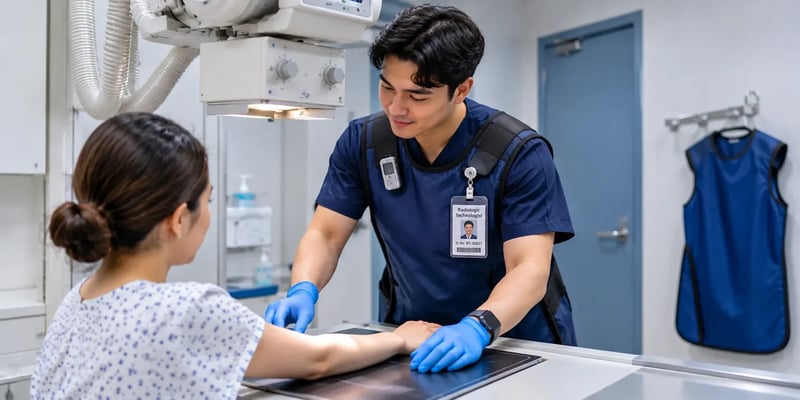
The pace depends on where you work. An outpatient imaging center may book a handful of scheduled patients, while a busy emergency department sends a steady stream. One hour you might x-ray a broken wrist, and the next you might run a CT scan or take a chest image at the bedside. Technicians work alongside radiologists, nurses, and other technologists, so the job is hands-on but rarely isolating.
Is Radiology Tech a Good Career?
For the right person, yes. BLS lists an associate degree as the typical entry-level education for radiologic technologists and projects 5 percent growth from 2025 to 2035, faster than the average for all occupations. Demand comes from an aging population and steady use of medical imaging.
It is a weaker fit if you want a desk job or fully predictable hours. The work is physically active, involves nights and weekends in many settings, and asks for constant attention to radiation safety. If you want patient contact, a clear path to specialize, and good pay without medical school, it is one of the stronger options in healthcare.
Radiology Tech Pros and Cons at a Glance
Pros | Cons |
|---|---|
Median pay of $80,110 a year (May 2025) | Long hours on your feet, plus lifting and repositioning patients |
Entry with a two-year associate degree | Clinical hours during school are usually unpaid |
5 percent projected growth and about 15,300 openings a year | Nights, weekends, holidays, and on-call time in many settings |
Jobs in hospitals, imaging centers, clinics, and travel roles | Pay can level off unless you add a specialty |
Clear paths into CT, MRI, and mammography | 24 continuing education credits every two years |
Pros of Being a Radiology Technician
Short Training Path
Most technicians enter with a two-year associate degree, skipping the cost and years of medical school or a bachelor's degree. Some states also license limited x-ray operators after a shorter certificate, but that role covers fewer exams, so check what your state allows before you choose that route.
Strong Job Demand
BLS projects about 15,300 openings a year for radiologic and MRI technologists through 2035. Diagnostic imaging is central to modern medicine, and an aging population keeps that need steady.
Competitive Salary
The top 10 percent of radiologic technologists earn more than $118,660. Adding credentials in CT, MRI, or mammography, or moving into lead and supervisor roles, is how most technologists climb toward that range.
Flexible Work Settings
Hospitals, outpatient centers, physicians' offices, and travel staffing agencies all hire technicians. Because many facilities run around the clock, part-time, evening, and weekend arrangements are common.
Brief Patient Interactions
You work directly with patients, but usually for the length of an imaging procedure rather than a whole shift. If you like helping people without the sustained intensity of bedside nursing, that rhythm is a real draw.
Cons of Being a Radiology Technician
Physical Demands
Expect long stretches on your feet, plus lifting and repositioning patients who may have limited mobility. Over the years, the standing and lifting can wear on your back, knees, and joints, which is why body mechanics training matters from day one.
Unpaid Clinical Hours
Clinical rotations are a required part of accredited programs, and they are usually unpaid. They can fill most of your week during the clinical phase, so plan how you will cover your bills while you are in school.
Radiation Exposure
Working near ionizing radiation is the concern most people raise first, and it is closely controlled. You wear a dosimeter that measures your dose, use lead shielding, and follow distance and positioning rules. Federal rules cap occupational exposure at 5 rem (50 millisieverts) a year for the whole body under 10 CFR 20.1201, and state radiation-control programs apply comparable limits to x-ray work. The precautions are constant, and they become part of your daily routine.
Irregular Schedules
Because hospitals operate around the clock, schedules often include evenings, weekends, holidays, and on-call rotations, especially early in your career. If you need a strict nine-to-five, this may be the hardest part of the job to accept.
Pay Can Level Off Without a Specialty
General x-ray work has a ceiling. Technologists who want to keep raising their pay usually add a credential in CT, MRI, mammography, or interventional imaging, or move into a lead role.
New-Grad Hiring Depends on Location
Openings are not spread evenly. Some areas have more graduates than entry-level jobs, while others struggle to fill shifts. Look at job postings near you, and ask programs where their recent graduates were hired.
Emotional Stress and Continuing Education
You image patients who are in pain, frightened, or seriously ill, and that can build up over time. You also keep studying after you are hired: ARRT requires 24 approved continuing education credits every two years, called a biennium, to keep your credential active, as described in its ongoing requirements.
Radiology Technician Salary and Job Outlook
BLS reports a median annual wage of $80,110 for radiologic technologists and technicians as of May 2025, about $38.51 an hour. New graduates usually start lower, with the bottom 10 percent earning less than $55,980.
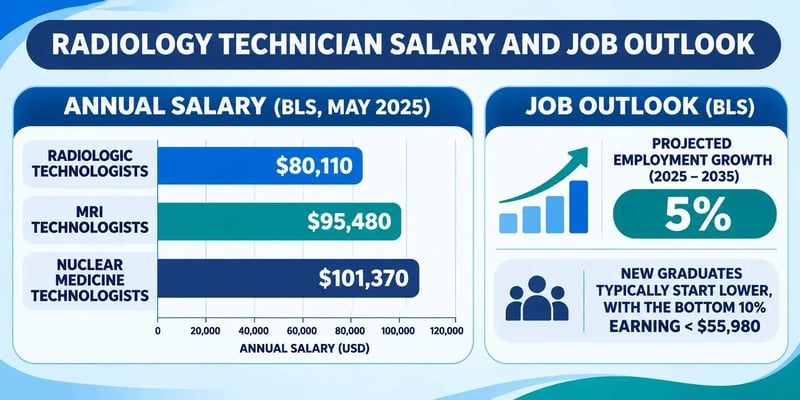
BLS projects 5 percent employment growth from 2025 to 2035. Specializing pays: MRI technologists earned a median of $95,480 in May 2025.
Who Radiology Technician Work Suits Best
A quick gut check before you commit to training.
This career likely suits you if you:
- Want hands-on healthcare work without a four-year degree or medical school
- Are comfortable on your feet and physically active through a shift
- Can handle some nights, weekends, or on-call time
- Like technical work with room to specialize later
It may not suit you if you:
- Want a desk-based or fully predictable nine-to-five schedule
- Prefer to avoid physically demanding work
- Would rather not follow radiation-safety routines every day
- Want to stop formal learning once you are credentialed
If the first list sounds like you, see which radiology technician classes near you are taking students.
Is Rad Tech Worth the Cost of Training?
For most students who finish an accredited program and pass the ARRT exam, yes. Tuition varies widely by school. JRCERT lists in-district tuition of $3,648 a year at College of DuPage in Illinois and $20,880 a year at ECPI University in Northern Virginia. At ECPI's rate, its 18-month program comes to about $31,000 in tuition, a little over half of the $55,980 that the lowest-paid 10 percent of technologists earn in a year. At community college rates, the gap is far wider. Add the $225 ARRT exam fee and any state license fee to your budget.
For the full step-by-step path, see how to become a radiology technician. If speed or price matters most, compare the fastest and cheapest radiology tech programs.
Radiology programs to compare on Dreambound:
- ECPI University's medical radiography associate degree: a hybrid AAS in as little as 18 months. It is JRCERT accredited, and JRCERT reports that 77 of 93 graduates (83 percent) passed the credentialing exam on the first attempt and 90 of 92 (98 percent) found jobs from 2021 to 2025.
- CCI Training Center's radiology technician training: an 8-month limited-scope x-ray certificate, not a full radiography degree. It suits students in states that license limited x-ray operators. CCI holds institutional accreditation from ACCET, which is different from JRCERT program accreditation.
Frequently Asked Questions
What are the downsides of being a radiology technician?
The main downsides are physical strain from standing and lifting patients, unpaid clinical hours during school, daily radiation-safety precautions, and schedules that can include nights, weekends, and on-call shifts. The work can also be emotionally hard when patients are seriously ill, and you need continuing education to keep your credential.
Is it hard to become a radiology tech?
The coursework is demanding. You study anatomy, imaging physics, patient positioning, and radiation safety, and you complete clinical hours in a hospital or imaging center. Getting in can also be competitive at community colleges, where seats are limited.
Which radiology tech gets paid the most?
Among related imaging roles, nuclear medicine technologists earned a median of $101,370 in May 2025. Within radiologic technology, MRI technologists (median $95,480) and technologists who add CT, mammography, or interventional credentials typically earn the most.
Will AI replace radiology technicians?
It is unlikely in the foreseeable future. AI tools increasingly help read and flag images, but they do not position patients, run equipment, or provide the hands-on care that imaging requires.
Is Radiology Technician Right for You?
Radiology tech is a strong choice if you want hands-on patient work and solid pay without a four-year degree, and you are comfortable with physical, shift-based work and ongoing learning. It is a weaker fit if you want predictable desk hours.
If the trade-offs sound workable, the next step is an accredited program. Compare radiology technician classes near you and check each program's accreditation before you apply.