How to Become a Carpenter

See if you qualify for Carpentry programs
Answer a few questions in 2 minutes. Free, no commitment.
To become a carpenter, start with a high school diploma or GED, then learn the trade through a paid apprenticeship, a carpentry program at a trade school, or an entry-level job as a carpenter's helper. A full apprenticeship usually takes three to four years. Carpenters who work for a contractor rarely need a license of their own, but many states require a contractor license or registration once you take on jobs as your own business. The Bureau of Labor Statistics (BLS) reports a median wage of $60,580 for carpenters in May 2025 and projects 4 percent job growth from 2025 to 2035.
Key Points
- A high school diploma or GED is the usual starting requirement. You don't need a college degree.
- Apprenticeships pay you while you learn. Registered programs require at least 2,000 hours of on-the-job learning, and federal rules recommend 144 hours of classroom instruction for each year.
- There is no national carpenter license. Licensing is set by each state, and sometimes by cities, and it mostly applies to contractors rather than employees.
- OSHA 10-hour safety training is often required to work on a job site, and NCCER credentials give employers proof of your skills.
- Pay rises with skill. The top 10 percent of carpenters earned more than $99,910 in May 2025.
How to Become a Carpenter in 5 Steps
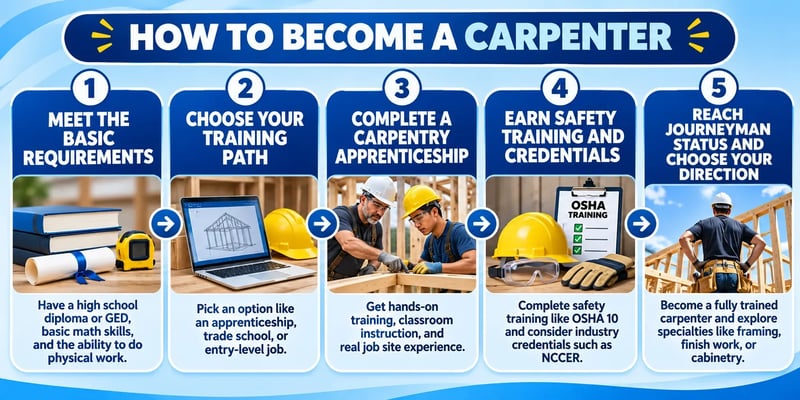
1. Meet the Basic Requirements
Most apprenticeship sponsors, schools, and employers look for the same starting points:
- A high school diploma or GED. BLS notes that math and mechanical drawing classes are useful preparation.
- Basic math for measuring and cutting, including fractions, angles, and simple geometry.
- Physical stamina and good hand-eye coordination for lifting, kneeling, climbing ladders, and working outdoors in heat and cold.
- A driver's license and reliable transportation, since many carpenters travel between job sites.
- Your own hand tools. BLS points out that many employers expect carpenters to bring them.
Many construction employers and apprenticeship programs look for applicants who are at least 18. Federal rules for registered apprenticeships set the minimum age at 16 and no upper limit, so people also switch into carpentry in their 30s, 40s, and later. If you are still a student, you can start preparing for carpentry in high school through shop classes and summer jobs.
2. Choose Your Training Path
There are three common ways into the trade. Many carpenters combine them, for example by finishing a short program before applying to an apprenticeship.
Path | How you learn | Typical length | Paid while training? |
|---|---|---|---|
Registered apprenticeship (union or nonunion) | Paid work on job sites plus classroom instruction | 3 to 4 years for most programs | Yes, with raises as your skills grow |
Trade school or community college program | Classroom lessons and hands-on shop work in carpentry or building construction | A few months for a certificate, about 2 years for an associate degree | No, though some schools help with job placement |
Entry-level helper or laborer job | Learning on the job from experienced carpenters | Varies by employer | Yes |
A program can help you land a better apprenticeship spot or a first job, because you show up already knowing tool safety and the basics. To weigh your options, compare carpentry classes near you by format and schedule, or see the cheapest and fastest carpentry programs if cost and time matter most.
3. Complete a Carpentry Apprenticeship
An apprenticeship is the most common route to becoming a fully trained carpenter. According to BLS, unions and contractor associations sponsor most programs. On the union side, that usually means a training center affiliated with the United Brotherhood of Carpenters (UBC). Nonunion programs often run through contractor groups such as Associated Builders and Contractors (ABC).
Union programs tend to follow a set application process. The Eastern Atlantic States Regional Council of Carpenters, for example, describes its four-year apprenticeship as earn-while-you-learn, with wages and benefits throughout training. Applicants attend an information session, apply online, take a skills and math assessment, and interview before a committee makes selections.
Programs registered with the U.S. Department of Labor follow federal apprenticeship standards. Under those rules, a time-based program requires at least 2,000 hours of on-the-job learning, recommends at least 144 hours of related classroom instruction for each year, and pays apprentices on a wage scale that rises as they gain skills.
During the program you learn carpentry basics, blueprint reading, math, building codes, and safety and first aid. BLS lists specialized training as well, including concrete forms, rigging, welding, scaffold building, and work in confined spaces. You can search registered programs on Apprenticeship.gov, or contact a local union training center or ABC chapter directly.
4. Earn Safety Training and Credentials
Safety training comes first. Skill credentials then help you stand out when you apply for apprenticeships and jobs.
OSHA 10-hour construction training. This course covers job site hazards such as falls, electrical work, and scaffolds. OSHA describes its Outreach Training Program as voluntary and says the course card is not a certification. Even so, some states, cities, and employers require the card before you can work on a site, and BLS lists the 10-hour course as standard training for carpenters. A longer 30-hour course covers the same hazards in more depth and is common for foremen and supervisors.
NCCER carpentry credentials. The National Center for Construction Education and Research (NCCER) offers a three-tier carpentry curriculum: General Carpentry, Advanced Carpentry: Frame and Finish, and Form Carpentry. Many apprenticeships and trade schools teach it, and employers can verify NCCER credentials online.
BLS also notes that optional certifications by specialty can open up more work. Forklift or aerial lift training, first aid, and CPR are common examples.
5. Reach Journeyman Status and Choose Your Direction
When you finish an apprenticeship, you become a journeyman carpenter, meaning you are fully trained and can work without close supervision. From there, many carpenters specialize:
- Rough carpenters build concrete forms, scaffolds, and temporary structures.
- Framing and construction carpenters build and repair the structure of homes and commercial buildings.
- Finish carpenters install trim, molding, doors, stairs, and cabinets.
- Interior systems carpenters put up metal framing, drywall, and ceilings in commercial buildings.
- Millwork and cabinetry carpenters build and install custom woodwork and cabinets.
- Heavy construction carpenters build forms and supports for highways and bridges.
With experience, BLS says carpenters can move up to lead carpenter, first-line supervisor, or general construction supervisor, or start their own business as an independent contractor. That last step is where licensing usually comes in.
Do Carpenters Need a License?
No state issues a license to carpenters who simply work for a contractor. The requirement starts when you contract directly with customers or run your own business. Depending on the state, you may need a contractor license, a contractor or home improvement registration, or a license only for jobs above a certain dollar amount. About a dozen states, including Texas, New York, Illinois, and Colorado, have no state contractor license at all and leave the rules to cities and counties.
The table below shows what applies in each state and links to the official agency. Rules and dollar thresholds change, so confirm with the agency before you bid on a job, and check with your city or county as well. The median wage column comes from BLS data for May 2025.
State | What applies to carpentry work | Official source | Median pay (May 2025) |
|---|---|---|---|
Alabama | License for residential jobs over $10,000 and commercial jobs of $100,000 or more | $48,220 | |
Alaska | Contractor registration for paid construction work; a handyman registration covers jobs of $10,000 or less | $73,860 | |
Arizona | License unless the whole job is under $1,000, needs no permit, and is not part of a larger project | $58,580 | |
Arkansas | License for residential jobs over $2,000 and commercial jobs of $50,000 or more | $47,760 | |
California | License for jobs of $1,000 or more, any job needing a permit, or any job with employees; carpentry classes are C-5 and C-6 | $75,920 | |
Colorado | No state license; cities and counties set the rules | $62,830 | |
Connecticut | Home improvement contractor registration for residential jobs over $200 | $64,060 | |
Delaware | Every contractor registers with the state; no dollar threshold | $59,200 | |
District of Columbia | Home improvement or general contractor license | $61,710 | |
Florida | State license for structural carpentry (general, building, or residential contractor); none for cabinetry or interior work with no licensed task | $49,870 | |
Georgia | Residential contractor license for jobs over $2,500; some specialty trades are exempt | $49,350 | |
Hawaii | License for jobs over $1,500 or any job needing a permit; carpentry classes are C-5 and C-6 | $85,280 | |
Idaho | Contractor registration for jobs of $2,000 or more | $52,000 | |
Illinois | No state license except for roofers; cities such as Chicago license contractors | $79,000 | |
Indiana | No state license; cities and counties license contractors | $62,870 | |
Iowa | Contractor registration if you earn $2,000 or more a year from construction | $57,710 | |
Kansas | No state license except roofer registration; cities and counties set the rules | $56,960 | |
Kentucky | No state license; cities such as Louisville and Lexington license contractors | $52,680 | |
Louisiana | Registration for home improvement jobs over $7,500; license for residential and commercial jobs of $50,000 or more | $49,920 | |
Maine | No state license for general contractors or framing | $62,160 | |
Maryland | Home improvement license (MHIC) to contract with homeowners; no dollar threshold | $62,960 | |
Massachusetts | Construction Supervisor License (an individual license) to oversee structural work on homes, plus home improvement contractor registration | $75,200 | |
Michigan | Residential builder or maintenance and alteration contractor license; carpentry is a listed trade | $61,680 | |
Minnesota | Registration for carpentry-only work; a residential license if you offer more than one skill to homeowners | $64,930 | |
Mississippi | License for residential remodeling over $10,000, new homes over $50,000, and commercial jobs over $50,000 | $48,650 | |
Missouri | No statewide license; cities and counties set the rules | Check your city or county | $60,840 |
Montana | State construction contractor license (required since January 2026) | $58,820 | |
Nebraska | Contractor registration before starting work; no exam | $50,320 | |
Nevada | State license; carpentry is classification C-3 | $62,380 | |
New Hampshire | No state license | $61,200 | |
New Jersey | Home improvement contractor registration | $64,010 | |
New Mexico | State license, with a handyman exemption up to $7,200 a year | $59,720 | |
New York | No state license; New York City, several counties, and Buffalo license home improvement contractors | $72,330 | |
North Carolina | General contractor license for projects of $40,000 or more | $49,100 | |
North Dakota | License for jobs over $4,000 | $57,890 | |
Ohio | No state license for carpentry; cities and counties may register contractors | $60,810 | |
Oklahoma | No state license for carpentry or general contractors | $46,910 | |
Oregon | License for paid construction work, except casual jobs under $1,000 | $62,870 | |
Pennsylvania | Home improvement contractor registration if you do $5,000 or more of that work a year | $59,370 | |
Rhode Island | Contractor registration for nearly all residential and commercial work | $60,840 | |
South Carolina | Residential carpentry registration for jobs over $500, builder license over $5,000, commercial license over $10,000 | $50,670 | |
South Dakota | No state skills license; contractors need a contractor's excise tax license | $48,140 | |
Tennessee | License for projects of $25,000 or more; home improvement license for $3,000 to $24,999 in nine counties | $50,830 | |
Texas | No state license for general or carpentry contractors; cities set registration and permit rules | $48,900 | |
Utah | License for projects of $7,000 or more; handyman registration from $3,000 | $52,360 | |
Vermont | Residential contractor registration for jobs over $10,000 | $62,400 | |
Virginia | License for jobs over $1,000; finish carpentry is a specialty | $55,690 | |
Washington | Contractor registration for all construction work; carpentry specialties available | $74,190 | |
West Virginia | License for projects of $2,500 or more | $48,710 | |
Wisconsin | Dwelling contractor certification to pull permits for one- and two-family homes | $61,660 | |
Wyoming | No state license; cities and counties set the rules | $56,850 |
How Long Does It Take to Become a Carpenter?
Most people become fully trained carpenters in three to four years, which is the length of a typical apprenticeship. A certificate program takes a few months and an associate degree about two years, but most graduates still spend time on the job before they are considered fully skilled. For a stage-by-stage timeline, see how long it takes to become a carpenter.
Carpenter Salary and Job Outlook
BLS reports that carpenters earned a median annual wage of $60,580 in May 2025, or $29.12 an hour. The lowest 10 percent earned less than $40,410, and the highest 10 percent earned more than $99,910. Apprentices start below these figures and get raises as they progress.
Pay depends heavily on location. Median wages were highest in Hawaii ($85,280), Illinois ($79,000), California ($75,920), Massachusetts ($75,200), and Washington ($74,190), and lowest in Oklahoma ($46,910) and Arkansas ($47,760). The type of construction matters less. Carpenters in nonresidential building construction earned a median of $63,780, compared with $60,600 in residential building construction.
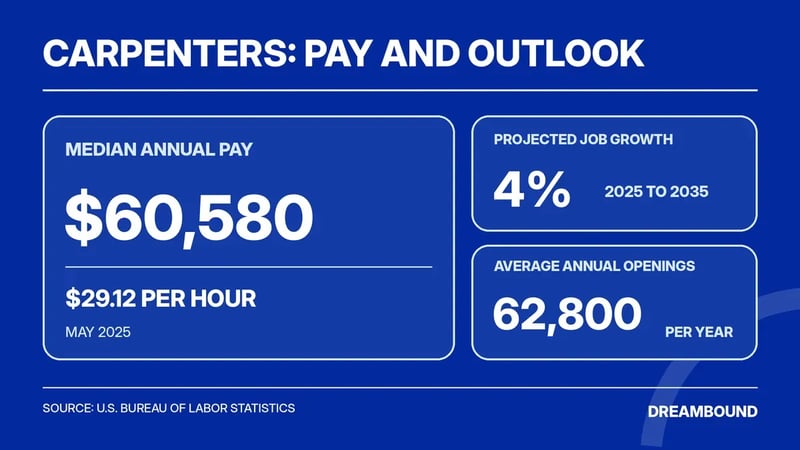
BLS projects employment of carpenters to grow 4 percent from 2025 to 2035, about as fast as the average for all occupations, with about 62,800 openings a year. Most of those openings will come from carpenters retiring or leaving the trade. New home building and factory construction add jobs, while modular and prefabricated building components reduce some of the on-site work.
Wondering whether the trade fits you? Read our breakdown of the pros and cons of a carpentry career.

Frequently Asked Questions
Can a carpenter make $100,000 a year?
Some do. The top 10 percent of carpenters earned more than $99,910 in May 2025, according to BLS. Higher earners tend to work in high-wage states, take on supervisory roles, or run their own contracting businesses.
Is carpentry a high-paying job?
It pays more than the typical job. The median wage for carpenters was $60,580 in May 2025, compared with $50,980 for all occupations, according to BLS. Pay also climbs with experience, specialty, and location.
Is 30 too late to become a carpenter?
No. Federal rules for registered apprenticeships set a minimum age but no maximum, and many people enter the trade in their 30s or later. Life experience, reliability, and comfort with math can work in your favor when you apply.
Do you need a degree to be a carpenter?
No. A high school diploma or GED is the typical requirement, and most carpenters learn through an apprenticeship or on the job. Some trade schools offer associate degrees in carpentry, but employers don't require one.
Is carpentry hard to learn?
Carpentry is physically demanding and takes years to master, but you learn it step by step. Apprentices start with simple tasks like measuring and cutting, then move on to reading blueprints and building full structures under the guidance of experienced carpenters.
Should I join a union or a nonunion apprenticeship?
Both pay you while you train, and both can lead to journeyman status. The better choice usually depends on which programs operate near you and who the main employers are in your area. Ask each program about its wage scale, schedule, and how it places apprentices with contractors.
Is a carpenter license the same as certification?
No. A license or registration is a legal requirement set by a state or city, and it usually applies to contractors. Certifications, such as NCCER credentials, are optional proof of your skills that employers may prefer.
Find Carpentry Training Near You
The fastest way to get started is to pick a training path and apply. Dreambound lists carpentry programs across the country, so you can find carpentry classes near you and compare program length, format, and schedule in one place.